

Read a Sounding From an Archive#
Estimated reading time: 6 minutes
tephpy reads two archive formats: the IGRA records published by
NOAA/NCEI, and the TEXT:CSV bodies the University of Wyoming’s archive
serves. Both hand back
a Sounding, and everything downstream — the
diagram, the analysis, the gallery — takes it from there without caring which
route it came by.
The package ships one radiosonde ascent in both formats so this page can show that. It is Camborne, 2026-07-21 12Z.
From an IGRA File#
igra.read(...) takes a path and the nominal launch
time that selects an ascent from it — a station file holds many:
from tephpy import samples
from tephpy.io import igra

from_igra = igra.read(
    samples.path("camborne-igra-12z"), time="2026-07-21 12:00"
)
For your own data, that path is wherever you downloaded the station file to.
samples.path(...) is only how this page gets hold of one;
samples.available() lists the names it
accepts. If your data is already in Python rather than in a file,
Build a Sounding From Your Own Data is the page you want.
From a Wyoming Body#
wyoming.parse(...) takes the response body as
text. station and time are metadata rather than parsing input — the body
carries neither — so pass them if you know them and the legend label derives:
from tephpy.io import wyoming

body = samples.path("camborne-wyoming-12z").read_text(encoding="utf-8")
from_wyoming = wyoming.parse(body, station="03808", time="2026-07-21 12:00")
The Same Ascent, Either Way#
Both are now Sounding objects over the same
balloon flight. Here they are on one diagram:
import matplotlib.pyplot as plt

fig, ax = plt.subplots(subplot_kw={"projection": "tephigram"})
ax.plot_sounding(from_igra)
ax.plot_sounding(from_wyoming)
ax.legend()
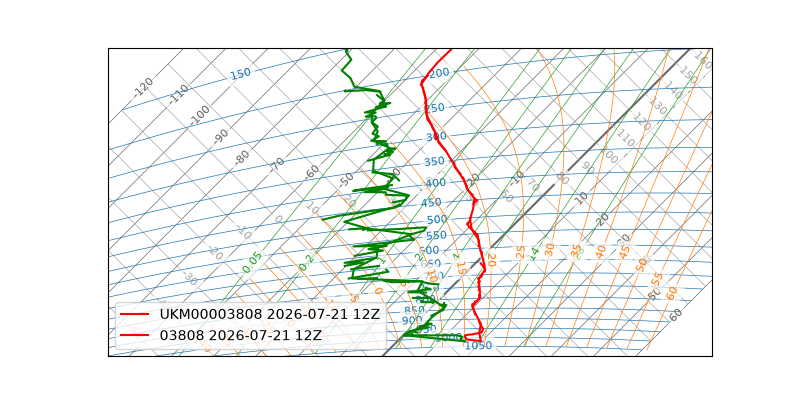
You cannot pick them apart, and that is the point of this page: the archives and the readers differ, and what comes out the far end does not. The legend carries two entries; the traces are one.
Two things about that pair are worth knowing before you compare readings of your own.
The archives thin differently. This IGRA record carries 263 levels and the Wyoming capture 61, because the Wyoming sample shipped here was thinned to keep it small. Neither is wrong; they are different samplings of one ascent, so a level-by-level comparison is not a fair test of either reader.
They name the station differently. IGRA identifies it as UKM00003808 — an
eleven-character identifier carrying a country and network code — and the Wyoming
archive as 03808, the bare WMO number that the identifier’s tail zero-pads.
The legends therefore differ, and neither is a defect.
What agrees is the atmosphere. Both put the surface near 1019 hPa at about 19.6 °C.
Fetching From the Network#
wyoming.fetch(...) does the download for you:
give it a station identifier and a time — wyoming.fetch("03808",
"2026-07-21 12:00") — and it returns the same
Sounding the section above built from a saved
body. It takes an optional timeout, and raises
TephpyIOError for a network failure, an
HTTP error, or a body it cannot read — one of the hierarchy
tephpy.exceptions describes, which except TephpyError catches
whole.
That call is described here rather than shown as a block, and the reason is a
feature of these pages. Every python block in the how-to, tutorial and
explanation guides is executed by the test suite, as one script per page and on
every supported Python version; the blocks that publish a figure, which is all of
them on this page, run again when the documentation is built. That is why you can
trust the ones above. A block calling fetch would reach the University of
Wyoming in both places — on every test run and every build — and would then fail
for reasons that have nothing to do with tephpy: a rate limit, an outage, a
proxy. So this page runs what it can and says plainly what it cannot.
You lose little by reading it rather than running it. fetch is parse with
a download in front: it requests the body and hands it to the same parser the
section above called directly, so a sounding you fetch and a sounding you
parse
are built by identical code. If you want to check it against your own network,
that is a Python prompt away.
Where to Go Next#
Your First Tephigram draws a sounding and names everything on it, and
Decode BUFR With ecCodes covers the formats tephpy deliberately does not
read — TEMP bulletins and BUFR messages — and what to reach for instead.